
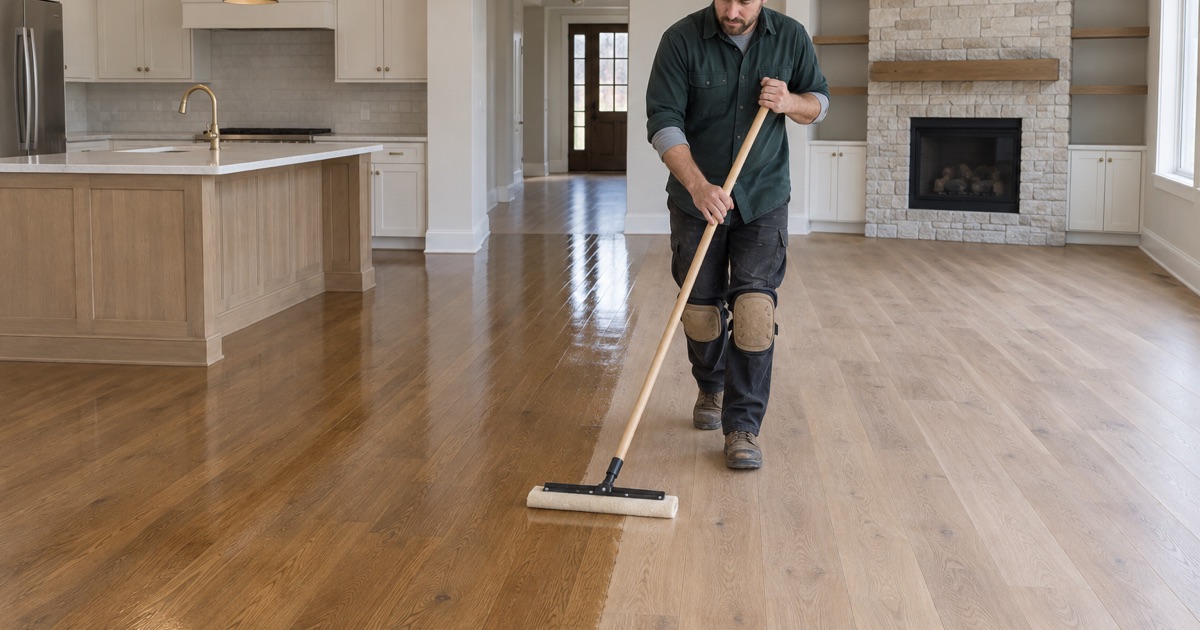
Eden Prairie Wood Flooring does hardwood floor recoating in Eden Prairie, MN, and has been recommending it over a full sand where it is the honest answer for 20+ years. A screen-and-recoat abrades the existing finish just enough for a fresh coat to bond, then puts that coat down. The wood itself is not touched, which is what makes it cheaper, faster and far less disruptive than refinishing.
It is also the service most often skipped past. A homeowner who has noticed a dull, scuffed floor usually asks for a refinish, because that is the word everybody knows. Quite often the finish is worn and the wood underneath is perfectly sealed, and the right answer costs a fraction of what was expected and takes days rather than a week out of the house.
The catch is that a recoat has a window. Once the finish has worn through in the traffic lanes and the wood is taking dirt and moisture directly, a coat over the top will not restore it and will not last. So the first thing we do is establish which side of that window your floor is on, and say so plainly — including the times the answer is that you have left it too long.
Whether Your Floor Is a Recoat Candidate
Wear in the Finish Against Wear in the Wood
This is the whole decision. Wear that has stayed in the finish film shows as dullness, fine scratching and a loss of sheen in the walking lanes, with the wood still sealed underneath. Wear that has reached the wood shows as gray or darkened patches, stains that have soaked in, and scratches you can feel with a fingernail. We check the traffic lanes, the doorways and an area under furniture for comparison.
The Recoat Window
Every finish has a period during which it can be abraded and recoated successfully, and it closes as the film thins. Keeping a floor inside that window is the cheapest way to own a wood floor, because each recoat resets it without removing any wood. A floor recoated on schedule can postpone a full sand by many years; one left past the window has already spent that saving.
Floors a Recoat Will Not Save
Some floors are past it, and pretending otherwise wastes your money. Bare or grayed patches, water staining that has penetrated, pet damage into the wood, cupping that has not resolved, and any floor still taking on moisture from a leak or a slab all need something other than a coat. We say which of those applies and quote the appropriate work instead.
What a Screen-and-Recoat Involves
Cleaning and Contamination
Most recoat failures are contamination failures. Acrylic polishes, wax-based products and oil soaps leave residue that a new coat will not bond to, and the peeling shows up weeks later when everyone has moved back in. The floor is cleaned thoroughly with products chosen for the purpose before anything is abraded, and any history of polish use is worth telling us about at the quote.
The Abrasive Screen and Buffer Pass
A buffer fitted with an abrasive screen takes the gloss off the existing finish and gives the new coat something to key into, without cutting into the wood. Edges, corners and under toe kicks are done by hand so the perimeter is prepared to the same standard as the field. The pass is uniform by design: an area missed shows up as a shiny patch under the new coat.
Adhesion Testing Before the Coat
Where there is any doubt about what is already on the floor, we abrade and coat a small test area and wait to see whether it bonds properly before committing to the whole house. That wait is an inconvenience of a day. Coating an entire floor that then peels is a full sand and refinish nobody budgeted for, so the test is worth the delay every time.
Products, Sheen and Timing
Matching the Existing Finish
Waterborne coatings will generally go over a properly abraded oil-modified finish, and the reverse combination is less reliable, so identifying what is on the floor matters. Where the original product is unknown, the test area settles it. We record the product and sheen we apply, so the next recoat has a documented starting point rather than another round of guessing.
Sheen Choice on a Recoat
A recoat can move the sheen, and that is the one visible change available without sanding. Going from a gloss to a satin will hide day-to-day scuffing and dust better in a room with a lot of light; going the other way makes the floor brighter and less forgiving. What it cannot do is change the color, and it will not disguise damage already in the wood.
Dry Time, Cure Time and a Cold House
A recoated floor is usually walkable quickly, but cure is the number that decides when furniture, rugs and pets return, and it is not the same number. Waterborne finishes cure faster than oil-modified ones, and a house held at a low winter thermostat setting extends both. We hand over the dry and cure times in writing rather than leaving anyone to judge by touch.
Where Recoating Earns Its Keep
Keeping a Refinish Further Away
A solid floor only has so many sandings in it, and every full refinish spends one. Recoating on a sensible cycle keeps the finish intact so the wood never has to be cut, which stretches the life of the floor by years. On a floor already sanded once or twice, that arithmetic stops being about money and starts being about how much floor is left.
Rental Turns and Commercial Spaces
For a rental unit or a small commercial space, a recoat between tenants restores appearance inside a short window with minimal downtime and no coarse sanding in an occupied building. We schedule against the handover date and build the coats where the traffic actually is. Property managers get a floor that looks maintained without the disruption of a refinish every cycle.
Engineered Floors With a Thin Wear Layer
Where an engineered floor has too little veneer to sand safely, a recoat is not merely the cheaper option — it is often the only one the floor can take. We measure the wear layer first, exactly as we would before quoting a sand, then recoat within what the product can support. That measurement is what keeps a maintenance visit from becoming a sand-through.
- 20+ Years Experience
- Free Written Quotes
- Moisture Readings on Every Quote