
Eden Prairie Wood Flooring handles water damaged hardwood floor repair in Eden Prairie, MN and has done for 20+ years, serving surrounding cities including Chanhassen, Shakopee, Edina, Minnetonka and Hopkins. We deal with supply line failures, dishwasher and refrigerator leaks, ice dam water coming in from above, sump failures and lower-level seepage, on solid and engineered floors and on every level of the house.
A wet wood floor is a clock. In the first day or two the water is mostly still in the boards, and a floor caught at that stage can often be dried, monitored and kept. After that it works into the subfloor and around the fasteners, the boards start to cup, and the question turns from drying to replacement. That is why the first call matters more here than on any other flooring job.
It is also why the first thing we do is document rather than demolish. The floor gets photographed and moisture-mapped room by room, with readings taken in the boards and in the subfloor, before any drying equipment runs or any board comes up. Once the work starts, the damaged floor no longer exists in the state the claim will be judged on, and nobody can go back and take those readings again.
The First Forty-Eight Hours
Standing Water, Wicking and the Subfloor
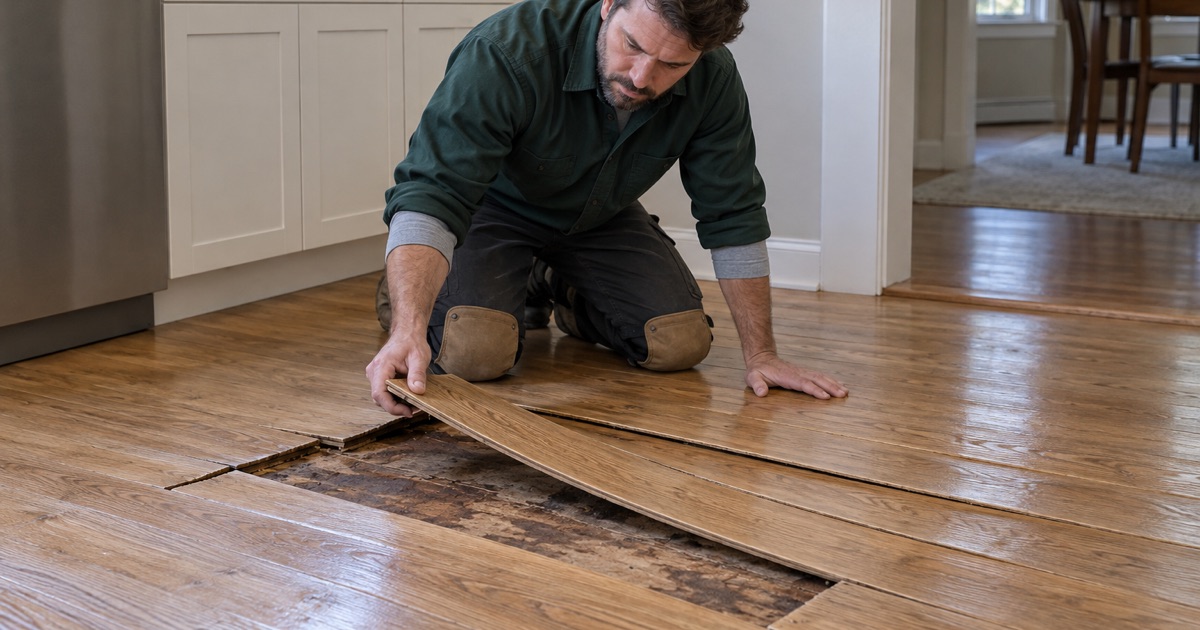
Surface water is the visible part and usually the smaller problem. Wood wicks along the boards and down through the tongue-and-groove joints, so the wet area underneath is routinely larger than the stain on top, and the subfloor can be holding water while the surface looks dry. We meter out from the source in a grid until the readings come back to normal, which is what actually defines the edge of the damage.
Moisture Mapping and Photographs Before Anything Moves
Before a fan is switched on we record the room, the source, the extent of the water and a numbered set of readings, with photographs of the boards, the transitions and anything stored on the floor. That map is the working document for the repair scope and the evidence base for a claim. Doing it afterward is not possible, and reconstructing it from memory is worth nothing to anyone.
Drying Equipment and What It Can Actually Save
Air movers and dehumidification can save a floor caught early, but drying is a controlled process rather than a race. Pulling moisture out of the face faster than it leaves the underside can turn cupped boards into crowned ones, which is a worse outcome than where you started. We monitor the readings through the drying and slow it where the boards need slowing, and we tell you honestly when the numbers say a floor is not going to come back.
Common Sources in Minnesota Homes
Ice Dams and Water Entering From Above
An ice dam backs meltwater up under the shingles and into the wall and ceiling, and what reaches the floor often arrives at an exterior wall rather than in the middle of the room. That means the wettest boards can be under the base and behind the casing where nothing is visible. We read along the perimeter and into the wall line, and we look for the staining pattern that says water came down rather than out.
Sump Pump Failure and Lower-Level Seepage
A sump that fails during a heavy event puts water across a lower level quickly, and a lower level is also where solid hardwood should not have been installed in the first place. We read the slab as well as the flooring, because a floor can be dried and then re-wetted by concrete that is still giving off moisture. Coverage for this class of loss commonly depends on whether a sewer backup and sump pump endorsement was added to the policy.
Appliance Leaks, Supply Lines and Slow Drips
Dishwashers, refrigerator ice lines, washing machine hoses and toilet supplies produce two very different events: a sudden discharge that floods a room, and a slow drip that has been going on behind a cabinet for months. The slow one is usually worse for the floor and worse for coverage. We trace the wet area back to the source and say which pattern the readings describe, since that distinction shapes both the repair and the claim.
Repair, Replace or Refinish
Cupped Boards That May Flatten
A cupped board is not automatically a lost board. Where the water was removed early and the drying is controlled, the moisture content differential across the board closes and much of the cup relaxes. We re-meter over days rather than deciding on day one, and we do not sand a cupped floor while it is still moving, because sanding a board that later flattens leaves it thin in the middle and permanently uneven.
Board Replacement, Weave-In and Subfloor Sections
Where boards have to come out, they come out to the edge of the wet reading rather than to the edge of the stain, and the subfloor underneath is inspected, dried or replaced in sections as its own readings require. New boards are woven several courses into the dry field so there is no straight seam marking the repair. Fastener type and spacing follow the flooring, not whatever was used originally.
Matching the Dry Rooms
A repaired area has to meet the untouched rooms convincingly, and new wood has none of the ambering the old floor has acquired. We test stain and sheen on the new boards against the existing floor and say plainly when a full-room sand is the only way to make it read as one surface. Like kind and quality is the standard a claim is measured against, so that judgment is worth making before the scope is finalized.
Working With Your Insurance Claim
Documentation the Adjuster Will Ask For
The usual asks are the source of the loss, dated photographs, the extent of the affected area, moisture readings and a scope with quantities. We supply the flooring half of that as a matter of course, in writing, with the readings that support each line. What we do not do is tell you what your policy covers, because that is a conversation between you and your insurer and a contractor guessing at it helps nobody.
Actual Cash Value, Replacement Cost and Recoverable Depreciation
These terms decide what actually lands in your account. Actual cash value settles at depreciated value, replacement cost settles at what it costs to replace, and recoverable depreciation is the balance released once the work is done and documented. Knowing which one your policy runs on changes the order in which you do things, and it is worth establishing before the repair is scheduled rather than after the invoice.
Sewer Backup and Sump Pump Endorsements
Standard homeowners policies commonly exclude water that backs up through a sewer or drain or overflows from a sump, and the cover for it is an endorsement that has to have been added beforehand. In a metro where lower levels are normal and finished, that endorsement is the difference between a covered loss and an uncovered one. We document the event the same way either way, so you have the evidence whichever answer your policy gives.
Our Step-by-Step Water Damaged Hardwood Floor Repair Process
Source, Readings and Photographs
First visit: confirm the source is stopped, photograph the floor and the surroundings, and map moisture readings in the boards and the subfloor out to the point where they return to normal. Nothing is moved or dried before that record exists.
Controlled Drying and Monitoring
Drying equipment is placed and then monitored against repeat readings rather than run flat out. The target is to close the difference between the face and the underside gradually, and the readings decide when to stop rather than a set number of days.
Scoped Repair or Replacement
From the final readings we scope what is dried and kept, what is replaced, and whether the subfloor needs work. The quote names quantities, replacement stock, fastener schedule and whether the job ends in a spot blend or a full-room sand.
Refinishing, Blending and Handover
New boards are woven in, the affected area is sanded through the written grit sequence where required, and the finish and sheen are matched to the rest of the house. We hand over the dry and cure times in writing along with the full documentation set for your records.
- 20+ Years Experience
- Free Written Quotes
- Moisture Readings on Every Quote